Sitting still all day is wreaking havoc on your hips and spine – an expert recommends these three desk exercises to maintain mobility
As fitness goals go, maintaining mobility is rather a good one, allowing you to move freely and easily and physically live life to the full for decades to come.
The best way to achieve this is to move in varied ways – the body adapts to handle the things we consistently ask it to do. But we live in a time when movement is becoming less necessary, and our joints are suffering as a result.
The age of desk jobs, sedentary hobbies and more time spent on screens has left millions with stiff hips and tight spines, unable to complete basic physical tasks without discomfort. But there is an obvious way to counter this.
“When we’re dealing with an adaptation from stillness, movement is the answer, so any movement is better than just being still,” says human movement specialist and The Training Stimulus founder Ash Grossmann. “Most people just need more movement overall.
“Try to break up sitting time as much as you can, and think about moving your body as much as possible in as many ways as possible.”
All movement is a good antidote to excessive stillness, but there are certain movements that offer more bang for your buck than others in your mission to maintain mobility. Below, Grossmann walks you through three of his favourites, all of which you can do at your desk.
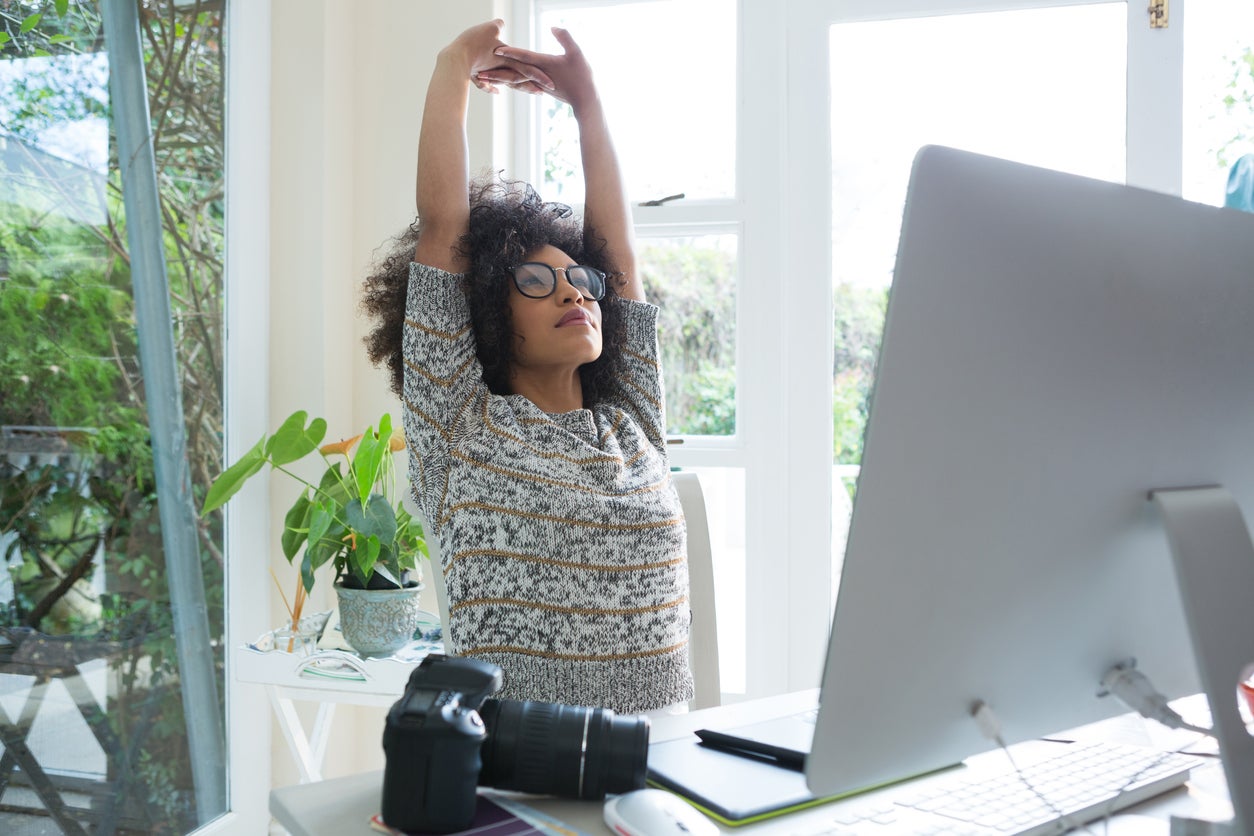
Seated rotation and side bend
Reps: 3-5 pulses in each direction
Keep your spine long, try to rotate around an axis, then relax and breathe into the movement – don’t strain to gain more rotation. Perform gentle pulses when reaching your arm overhead.
“We don’t live on pieces of paper – the body moves in three dimensions,” Grossmann says. “The three planes of motion are sagittal (up, down, forwards and backwards), frontal (side to side) and transverse (rotating left and right).
“When we do strength training, we focus on sagittal movements because it’s easiest to apply load in line with gravity. That’s better than nothing, but we’re only stimulating one third of the possible planes of motion our joints could be experiencing.”
This is why he’s a big proponent of inserting bending and twisting movements into your day, such as the seated rotation and side bend above.
“We spend a lot of our time hunched over our keyboard or curled around our phone with flexed spines,” Grossmann says. “If we can add some bending and rotation, it restores the often stiff movements of the spine, which are really important in everyday life.
“If you see someone who looks very stiff and awkward in the way they walk, it’s quite often because they lack the ability to side bend or rotate through their spine. Whereas if you see someone who looks fluid, generally their shoulders and hips will be able to dissociate because they’re able to get movement through the spine.”
Bulgarian split squat pulses with 3D drivers
Reps: 3-5 pulses in each direction
Aim to gently push the hips forward throughout.
The hip flexors are the muscles found on the front of the hips, with the primary function of moving your knee toward your chest. When you sit at a desk all day with your thighs supported by your chair, these hip flexors are inactive and held in a shortened position.
By doing this consistently, you are telling your body you value the ability to sit down, so it adapts by tightening the hip flexors – it’s making you more efficient at sitting. For many people, this is the root of stiff hips.
“With this exercise, you’re moving your hips in three directions to undo some of the tightness we get from sitting down all day,” Grossmann says. “It’s an effective way of opening up tight hip flexors because we’re getting these muscles into a lengthened position in all three planes of motion.
“We get a bit of stability work and load through the standing leg as well.”
Wide stance good morning reaches
Reps: 3-5 reaches in each direction
Don’t let your weight shift into your forefoot or your heels come off the floor.
“Here, we’re getting some length through the posterior chain and the adductors on the inner thigh, and doing it in three dimensions,” Grossmann says. “It’s a really easy way to get a hip opening exercise at your desk.
“You’ll feel your hips open up to a much greater extent than the classic forward fold stretch as you’re getting a lot more relative motion between your pelvis and your femurs.”
Read more: Why stretching isn’t the answer to tight muscles – and the exercises to try instead
How to use these exercises
You do not need to dedicate a focused hour of your day to these exercises. Instead, Grossmann recommends finding a few five-minute windows during your nine-to-five and evening to work your way through them.
“Set a five-minute timer or put a song on then, until it ends, do a few movements that feel good,” he says. “If you have a couple of intervals like that during the day, the positive impacts will start to accumulate. A stretch that was always tricky might start to open up, or maybe an old niggle starts to ease off.”
It is also important to approach each exercise gently – no movement should be uncomfortable. Start with smaller movements, then, if these feel good, you can increase the range of motion. For example, reaching further overhead during the rotation and side bend.
Read more: The common foods that can reduce inflammation and improve heart health, according to experts
Why are these exercises effective?
These exercises require you to move your body in a variety of ways, accessing a wide range of motion around several joints. This stops these movements from becoming “rusty”, or being lost for good.
“With movement patterns, our body very much operates on a use-it-or-lose-it basis,” Grossmann explains.
If you stop using a certain movement, the body views it as surplus to requirements and allows the tissues involved to weaken. Your body then actively avoids using them, leaving nearby muscles and alternative movement patterns to pick up the slack – “Our comfort zone narrows,” as Grossmann puts it.
This goes some way to explaining why you could touch your toes as a teen. Yet, after not doing it for decades, they are out of reach as an adult. The key to maintaining healthy joints is to never stop using them for their intended purposes.
A lack of use, on the other hand, leads to tissues becoming weaker and less resistant to injury. The surrounding muscles that compensate for this weakness are also at greater risk of overuse.
“For example, if you never do hinge movement [like deadlifts] in your training, then you suddenly bend over to pick something up from the floor, you might throw your back out – it’s overloaded because you’re only using your back and not your hips and hamstrings,” Grossmann explains.
“This applies to all movements. We want to keep our options open by exercising in a way that expands our comfort zone. That way, when life or sport presents varied challenges, our body is well prepared to respond effectively.”
Read more: What foods nutrition experts really eat to stop chronic illness in old age (and always avoid)